


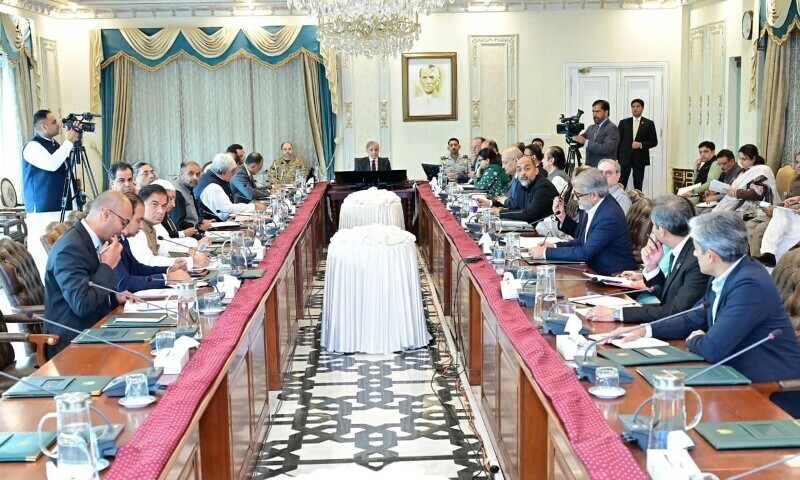

KARACHI — Planning Minister Ahsan Iqbal on Monday described Pakistan as a “natural maritime bridge” connecting the East and the West, as he inaugurated the second edition of the Pakistan International Maritime Expo and Conference (PIMEC 2025) at Karachi’s Expo Centre.
The four-day event, organised under the Pakistan Navy’s patronage with the support of federal and provincial departments, has brought together maritime industry leaders, government representatives, and investors from 45 countries to explore opportunities in Pakistan’s growing blue economy.
Speaking at the inauguration, Ahsan Iqbal said Pakistan’s strategic location gives it unmatched importance in the global maritime landscape, with South Asia, Central Asia, the Middle East, and Africa converging in its geographical corridor. “Pakistan stands as a natural maritime bridge between the East and the West,” he said, adding that the country’s position could make it a vital player in global trade and logistics.
However, the minister expressed concern that despite such potential, the maritime sector contributes less than 1% to Pakistan’s GDP far below the 4–7% seen in other maritime economies. He called for a unified national effort to unlock this underutilized sector.
Highlighting Pakistan’s more than 1,000-kilometre coastline and an exclusive economic zone of nearly 290,000 square kilometres, Iqbal said the nation possesses immense untapped resources in renewable energy, fisheries, and deep-sea minerals.
He linked the government’s Uraan Pakistan Vision 2035, which aims to transform the country into a $1 trillion economy, with his ministry’s 5Es framework focusing on Exports, e-Pakistan, Equity and Empowerment, Environment and Climate Change, and Energy and Infrastructure.
Iqbal further said that eight key drivers had been identified for export-led growth, including agriculture and food processing, manufacturing, IT and digital services, mines and minerals, skilled manpower, creative industries, tourism, and the blue economy.
“In this age of interconnectedness, oceans have once again become the highways of commerce, energy, and communication,” he noted. “Those who manage their maritime assets wisely are shaping the future of global economic power. The world’s prosperity, quite literally, sails on the seas.”
Citing UNCTAD data, the minister said over 80% of global trade by volume and 70% by value moves through the sea, while the global blue economy generates more than $2.5 trillion annually and supports over 350 million jobs.
He added that the true spirit of the modern blue economy lies in “seeking God’s bounty through trade, innovation, and exploration while being responsible stewards of His creation.”
Sindh Chief Minister Murad Ali Shah, who also attended the ceremony, called PIMEC “a great opportunity” for Pakistan’s maritime and industrial development. “This platform brings together global business leaders and opens new doors for investment,” he said, reiterating the Sindh government’s commitment to strengthening international maritime cooperation.
This year’s PIMEC features 150 local and 28 international exhibitors, with delegations from 44 countries, including the UK, Saudi Arabia, China, Egypt, and Turkiye. Experts believe Pakistan’s maritime sector could contribute over $100 billion annually to the national economy if its full potential is realized.


