
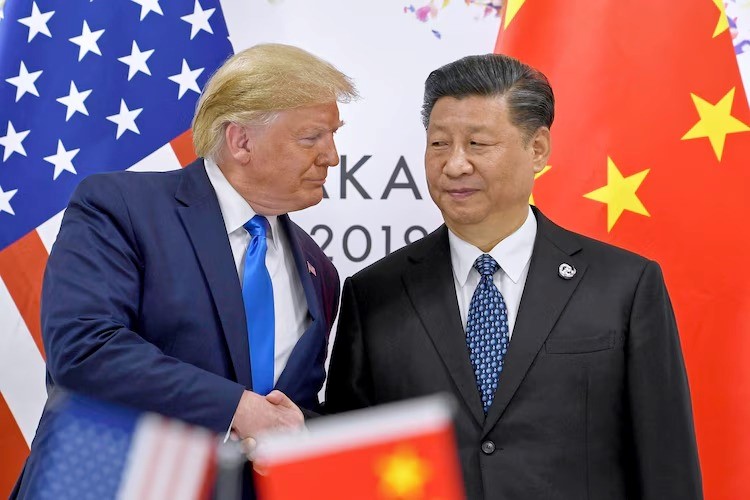
WASHINGTON — President Donald Trump announced Friday that the United States will impose a new 100% tariff on all Chinese imports starting November 1, a move that further escalates tensions between Washington and Beijing and sent financial markets tumbling.
The decision came just one day after China introduced sweeping export restrictions on rare earth minerals, critical materials used in semiconductors, electric vehicles, and other high-tech products.
In a fiery post on social media, Trump said the new tariffs were a direct response to what he called China’s “extraordinarily aggressive” trade stance. He claimed Beijing had issued “an extremely hostile letter to the world,” warning that it would impose “large-scale export controls on virtually every product they make and even some they don’t.”
Calling China’s move “unprecedented” and a “moral disgrace,” Trump declared that his administration would strike back. “Starting November 1, we will impose a 100% tariff on all Chinese imports over and above any tariff they are currently paying,” he said.
The U.S. already levies a 30% tariff on Chinese goods, down from a high of 145% earlier this year. Trump also announced plans for new export controls on critical software technologies, saying the measure was necessary to protect U.S. national interests.
Market Reaction and Economic Fallout
The president’s announcement rattled Wall Street. The Dow Jones Industrial Average dropped 385 points (0.8%), while the S&P 500 slid 1.25% and the Nasdaq lost 1.75%. Investors expressed concern that the latest tariffs could undo months of fragile economic recovery and derail the ongoing trade truce.
Trump: “China’s Actions Came Out of the Blue”
Speaking from the Oval Office later that day, Trump described Beijing’s latest trade restrictions as “shocking” and said they appeared to have “come out of the blue.”
“This isn’t something I instigated,” he told reporters. “It was a reaction to something they did and it wasn’t just aimed at us, it was aimed at the entire world.”
Still, Trump appeared to leave room for diplomacy, adding, “We’ll see what happens.”
Earlier in the day, Trump warned that China should not be allowed to “hold the world captive,” accusing Beijing of using its control over key materials to pressure other countries. “That seems to have been their plan for quite some time,” he wrote.
Tensions Over Upcoming Xi Meeting
The escalating trade dispute also cast doubt over a planned meeting between Trump and Chinese President Xi Jinping at the upcoming APEC Summit in South Korea.
In his morning post, Trump suggested he might cancel the meeting altogether, saying, “I was to meet President Xi in two weeks at APEC, but now there seems to be no reason to do so.”
However, by evening, Trump appeared to soften his tone. “I’m still planning to go to South Korea,” he told reporters. “Whether the meeting happens or not we’ll see.”
A Fragile Truce Nears Its End
The U.S. and China have been operating under a temporary trade truce since May, which helped ease tensions after months of tariff escalations. But that agreement is set to expire within weeks, raising fears that both sides are heading toward another full-scale trade war.
With rare earths, semiconductors, and critical technologies now at the center of the standoff, analysts warn that the global economy could face renewed volatility if talks collapse.
“What we’re seeing is a high-stakes chess match between two economic superpowers,” said a senior economist in Washington. “If neither side blinks, the consequences will ripple across the world.”