




- Khamenei calls Trump’s ultimatum “unacceptable”.
- “We must respond to the Zionist regime.”
- Russian officials claim Israeli strikes caused disaster.
Ayatollah Ali Khamenei, the supreme leader of Iran, on Wednesday declared that Iran would not give in to the demands of President Donald Trump. He cautioned the United States that stepping in to support its ally would cause “irreparable damage.”
Trump called for Iran’s “unconditional surrender” six days after the conflict began. He bragged about the United States’ capability to eliminate Khamenei, which sparked talk of potential military action.
Israel launched a large-scale bombing mission on Friday marking the start of the long-range assault. This led Iran to strike back using drones and missiles.
Khamenei gave a televised speech saying, “This nation will never surrender.” He called Trump’s demand “unacceptable.”
He warned the United States that any military attack would cause lasting harm. Earlier, Khamenei declared that Iran would show “no mercy” to its long-standing enemy after Trump pushed for Tehran’s total surrender.
“We must give a strong response to the terrorist Zionist regime. We will show the Zionists no mercy,” Khamenei wrote on X.
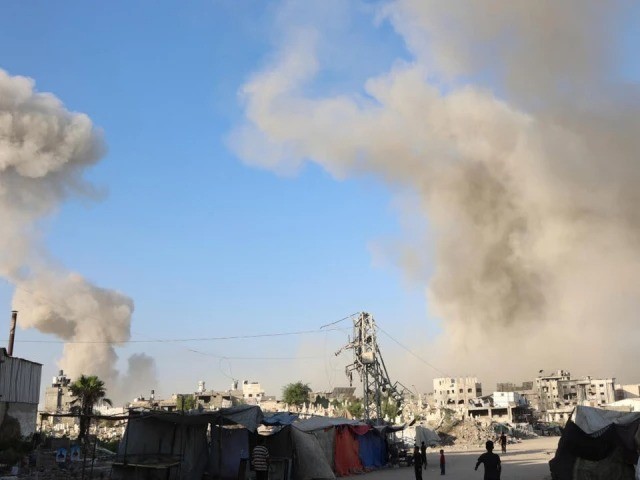
The statement came after a night of airstrikes. Israeli forces struck two buildings near Tehran that made parts for Iran’s nuclear programme. The UN nuclear watchdog confirmed this.
The Israeli military reported that over 50 fighter jets launched airstrikes around Tehran in recent hours. They said they targeted several facilities involved in creating weapons.
“In an effort to stop Iran’s nuclear weapons programme, a centrifuge production facility in Tehran was hit,” their statement added.
Centrifuges play a key role in uranium enrichment, which is a critical process used to create either reactor fuel or, if refined, the material for nuclear warheads.
The International Atomic Energy Agency reported that airstrikes destroyed two structures in Karaj, a suburb of Tehran, that had been producing parts used in centrifuges for Iran’s nuclear efforts.
Iran’s Revolutionary Guards announced they fired hypersonic Fattah-1 missiles aimed at Tel Aviv.
Hypersonic missiles move more than five times faster than sound and are capable of changing direction mid-air making it tougher to detect and stop them.
Iran also launched a “swarm of drones” targeting Israel. According to Israel’s military, 10 drones sent from Iran were intercepted.
It reported that one of its drones got shot down in Iran.
“Unconditional surrender”
Trump sparked rumors about possible US action when he left the G7 summit in Canada. The summit attended by leaders of wealthy democracies called to lower tensions but supported Israel’s “right to defend itself.”
He claimed the US could kill Khamenei.
Trump met the National Security Council to talk about the conflict. No public announcement followed the hour-long discussion.
Officials in the US emphasized Trump hasn’t yet decided on any action.
Israel’s strikes have targeted nuclear and military sites in Iran alongside homes in civilian areas.
Residential neighborhoods in Israel have come under attack, while foreign governments rushed to get their citizens out of both countries.
Sirens warning of Iranian missiles broke the sleep of many Israelis in Tel Aviv. People in the coastal city kept running to shelters throughout the night whenever alarms blared.
In Ramallah, a city in the West Bank sitting 800 meters (2,600 feet) above sea level, residents climbed onto rooftops and balconies to watch. From there, they could see Tel Aviv.
An AFP journalist noted cheers and whistles from the crowd as missiles streaked across the sky. Israeli air defenses responded by launching interceptions causing explosions mid-air that lit up the night.
Since Friday, Netanyahu’s office reported that over 24 people have died in Israel, and many have suffered injuries.
Iran claimed on Sunday that Israeli airstrikes killed at least 224 individuals, among them military officials nuclear scientists, and ordinary citizens.
Iran’s ISNA and Tasnim news agencies stated on Wednesday that authorities had detained five individuals suspected of being Mossad agents. They were accused of damaging the country’s reputation through online activities.
‘Nuclear facilities’
Israel described its sudden air attacks as an effort to stop Iran from getting nuclear weapons — something Iran denies aiming for.
The UN nuclear watchdog noted what seemed to be “direct impacts on the underground enrichment halls” at Iran’s Natanz site.
Israel keeps its nuclear activities unclear, but the Stockholm International Peace Research Institute states that it owns 90 nuclear warheads.
The fighting interrupted ongoing nuclear discussions between Tehran and Washington. Iran said after Israel began its campaign that it would refuse to negotiate with the United States while being attacked.


