




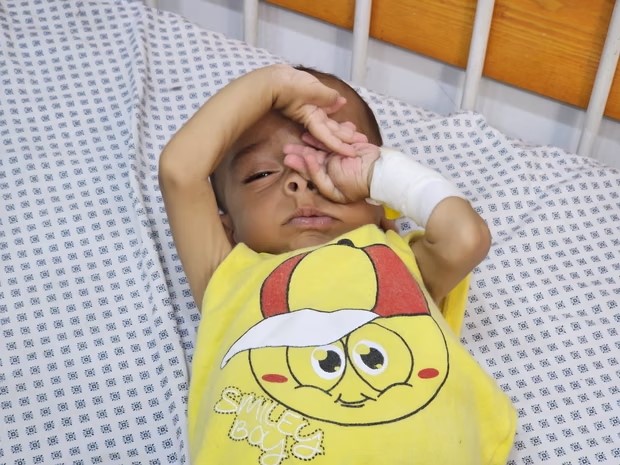
Mohammed’s thin arms poke out of a romper that says “smiley boy” next to a grinning emoji. In Gaza’s hospitals, the message feels cruel. The seven-month-old cries constantly from hunger or chews on his own bony fingers. He weighs less than 4 kilograms (9 pounds) and has been hospitalized twice. His face is sunken, limbs skeletal, and ribs sharply visible.
“I’m terrified I’ll lose my grandson to malnutrition,” says Faiza Abdul Rahman, his grandmother, who’s dizzy most of the time from lack of food. The previous day, all she ate was a single piece of pita bread that cost 15 shekels (£3). “His siblings are starving too. Some nights, they go to bed with nothing in their stomachs.”
Though Mohammed was born healthy, his mother couldn’t breastfeed due to her own malnutrition. The family has only managed to find two cans of formula since his birth.
The hospital ward run by the Patient’s Friends Benevolent Society is packed with severely underweight children—sometimes two to a bed. Only two pediatric teams remain in Gaza City, and up to 200 children show up daily.
Dr. Musab Farwana spends his days fighting to keep them alive. At home, he shares tiny meals with his own hungry children. His salary buys almost nothing. After a fellow doctor, Ramzi Hajaj, was killed while trying to collect food, Farwana avoids going near distribution sites run by the Gaza Humanitarian Foundation.
Food scarcity has reached a new extreme, despite repeated warnings of famine during the nearly two-year-long war. In just three days this week, 43 people died of hunger. Until then, the total recorded deaths from starvation stood at 68.
“We’ve faced hunger before, but never like this,” says Faiza. “This is the worst it’s ever been.”
Testimonies from residents and doctors, along with data from Israel, the UN, and aid groups, confirm food supplies are vanishing. Prices have exploded—flour now costs more than 30 times what it did at the start of the year.
Even those with money or connections aren’t safe. Over 100 NGOs including Save the Children, Oxfam, and MSF said in a joint statement: “We’re watching our own colleagues and partners starve in front of us.”
The AFP journalists’ union warned it may lose a colleague to starvation—the first such case in the agency’s history. WHO’s director-general, Tedros Adhanom Ghebreyesus, said on Wednesday that a “large proportion” of Gaza’s population is starving. “Call it what it is—mass starvation. And it’s man-made.”
Israel has blocked food entry for months. Since March, the total supplies allowed in fall far below even basic survival levels for the 2.1 million population. Many are already weakened by long-term malnutrition and repeated displacement.
“For almost two years, children here have endured famine. It’s not just about eating—it’s about getting vital nutrients, and those are missing entirely,” says Dr. Farwana.
That chronic lack of nutrition weakens immune systems. Compounding the crisis, basic medical supplies are scarce due to Israeli restrictions.
“Sometimes, a child just needs something simple to survive—and we can’t give it to them,” he says. Three children died this week in ICU. One girl could’ve survived if given IV potassium, a basic medicine now unavailable in Gaza.
“We tried oral substitutes,” he explains, “but due to her condition, she couldn’t absorb them.”
“These deaths stay with me. I can’t stop thinking about them. That girl could’ve gone home and lived. But a single missing medicine cost her life.”
Israel imposed a full siege on Gaza on March 2. On May 19, Prime Minister Netanyahu lifted it, saying the move was meant to prevent a starvation crisis—after allies warned him not to let images of famine circulate.
But instead of stopping the crisis, Israel just slowed it. Aid was allowed in trickles—not enough to halt starvation.
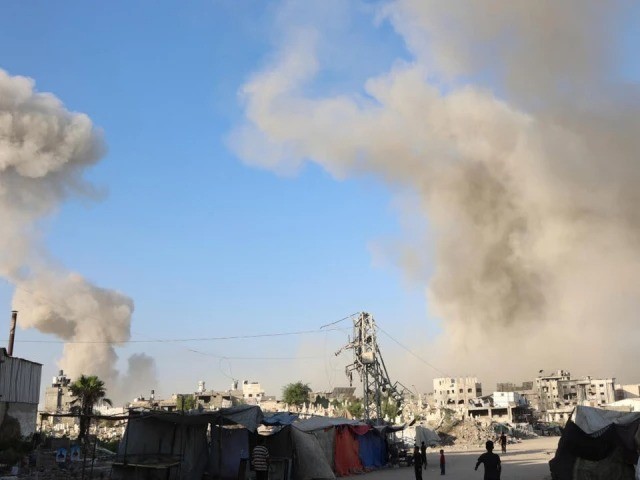
The aid now goes through a secretive, US-backed group operating four militarized distribution sites. Palestinians call them “death traps.” Hundreds have been killed trying to reach them, and even those who get food receive only a fraction of what’s needed.
By July 22, after 58 days of GHF operations, the food brought in could have fed Gaza for less than two weeks—if it were distributed fairly.
On Tuesday, Umm Youssef al-Khalidi decided to try her luck at a GHF site for the first time. She’d avoided them for months. Her youngest child is two, the oldest is 13, and her husband is paralyzed and wheelchair-bound.
“We’ve been quenching our hunger with water,” she says. “I’m more afraid for my family than for myself. What if something happens to me? Who’ll look after them?”
Last week, they went four days with no food. When they finally ate, eight people shared one bag of rice and two potatoes given by a stranger.
Before the war, her kids were bright students, always winning scholarships. Now, they sit on a sidewalk next to a bombed-out mosque, trying to sell bracelets instead of begging outright.
But no one’s buying. In a starving city, even cheap jewelry has no takers. Occasionally someone pities the scruffy, thin kids—but what they give doesn’t buy much.


